


A GP’s guide to skin cancer, sunshine and the changes you shouldn’t ignore.
Remember those long Australian summers? Days at the beach, backyard cricket, gardening, swimming, working outdoors and perhaps a few spectacular sunburns along the way?
You might have forgotten some of them, but your skin hasn’t!
Your skin remembers every summer, every sunburn and all those years of UV exposure. And sometimes, decades later, that damage can show up as skin cancer.
We’ve all heard of Slip, Slop, Slap. Most of us have been hearing it since childhood. But when did you last actually LOOK at your skin?
Not just your face in the bathroom mirror, but your back, shoulders, legs and those bits you haven’t seen since you could comfortably touch your toes!
As a GP, I spend a surprising amount of time looking at people’s spots, lumps and bumps. And there’s one word I want everyone to remember when it comes to skin cancer.
CHANGE.
Because that little spot that wasn’t there last summer might be trying to tell you something.
Your skin is your body’s largest organ. It provides a remarkable waterproof, flexible barrier, helps regulate temperature, protects against infection and allows us to feel the world around us.
And here’s something I regularly remind my patients:
Your skin is the one outfit you’ll wear every single day for the rest of your life. And unlike your favourite pair of jeans, you can’t replace it when it’s worn out!
So, let’s give it a little attention.
Australia is number one in skin cancer. Not exactly something to celebrate!
Australia has one of the highest rates of skin cancer in the world. This is certainly not an achievement we want, and it’s one we can do something about!
Our outdoor lifestyle, high ultraviolet (UV) radiation levels and the fair skin of many Australians combine to make skin cancer a major health issue.
There are three main types:
- Basal cell carcinoma (BCC): The most common, usually slow-growing and rarely spreading, but capable of causing significant local damage.
- Squamous cell carcinoma (SCC): Often develops on sun-exposed skin and can occasionally spread.
- Melanoma: Less common but potentially much more dangerous because it can spread to other parts of the body.
As a GP, I see skin cancers in people who have spent years working outdoors, but also in office workers, younger adults and people who thought they were doing everything right.
The good news? Most skin cancers are preventable, and early detection can make an enormous difference.
Know your UV, not just the temperature!
One of the biggest misconceptions I hear is that you only need sunscreen when it’s hot.
Not true!
UV radiation is invisible, and you cannot feel it. A cooler, breezy October day can deliver enough UV to damage your skin.
The Australian Bureau of Meteorology (BOM) publishes daily UV forecasts, and the UV Index tells you when sun protection is needed.
When the UV Index reaches 3 or above, it’s time to protect your skin.
Your Australian UV protection guide
| UV Index | Risk level | What should you do? |
| 1–2 | Low | Sun protection generally not required unless outdoors for extended periods or particularly sensitive |
| 3–5 | Moderate | Use sun protection |
| 6–7 | High | Use all five sun protection measures and seek shade |
| 8–10 | Very high | Minimise direct sun exposure, particularly around midday |
| 11+ | Extreme | Avoid unnecessary direct sun exposure and use maximum protection |
Important: This is a UV protection guide, not a recommendation for how many minutes to spend in the sun. There is no single safe exposure time for everyone.
Check your local forecast using the BOM UV Index or the Cancer Council’s SunSmart app. Keep one of these on your phone and use it to guide you.
UV levels change with the season, location, altitude and time of day. In much of Australia, particularly during spring and summer, protection is needed for large parts of the day.
Slip, Slop, Slap, Seek and Slide
Yes, the old campaign is still one of our best public health messages!
- Slip on protective clothing, preferably tightly woven or UPF-rated.
- Slop on broad-spectrum, water-resistant SPF50 or SPF50+ sunscreen. Apply generously about 20 minutes before going outside and reapply every two hours, or after swimming, sweating or drying off.
- Slap on a broad-brimmed hat that protects your ears and neck.
- Seek shade, especially during peak UV periods.
- Slide on sunglasses meeting Australian standards.
Remember your ears, scalp, neck, hands and the tops of your feet. These are areas I frequently examine in my consulting room!
Protect the right side of your face, neck and arms when driving. I regularly see nasty skin cancers in people who have been exposed to a lot of sun while driving.
Tanning beds are a definite NO, and there is a direct link to increased melanoma risk in people who use them.
For more excellent Australian advice, have a look at the Melanoma Institute Australia’s melanoma prevention and sun safety tips.
But doesn’t sunscreen cause cancer?
No. There is no convincing evidence that using approved sunscreens as directed causes cancer.
I know social media has plenty to say about sunscreen ingredients, but we need to separate speculation from good scientific evidence.
In Australia, therapeutic sunscreens are regulated by the Therapeutic Goods Administration (TGA). Ingredients are continually reviewed for safety.
Some sunscreen ingredients have attracted scientific scrutiny, but detecting an ingredient in the bloodstream does not automatically mean it causes harm.
If you’re concerned, choose a mineral sunscreen containing zinc oxide or titanium dioxide.
The important thing is to find a sunscreen you are comfortable using regularly. Check for any current product recalls or safety advice.
And remember, sunscreen is only one part of sun protection, not permission to spend all day baking in the sun.
Get to know your spots: ABCDE
You don’t need to become a dermatologist. You simply need to become familiar with your own skin.
The ABCDE guide is a useful starting point.
| Letter | What to look for |
| A – Asymmetry | One half looks different from the other |
| B – Border | Irregular, uneven or poorly defined edges |
| C – Colour | Several colours or changing pigmentation |
| D – Diameter | Often larger than 6 mm, although melanomas can be smaller |
| E – Evolving | Any CHANGE in size, shape, colour, sensation or appearance |
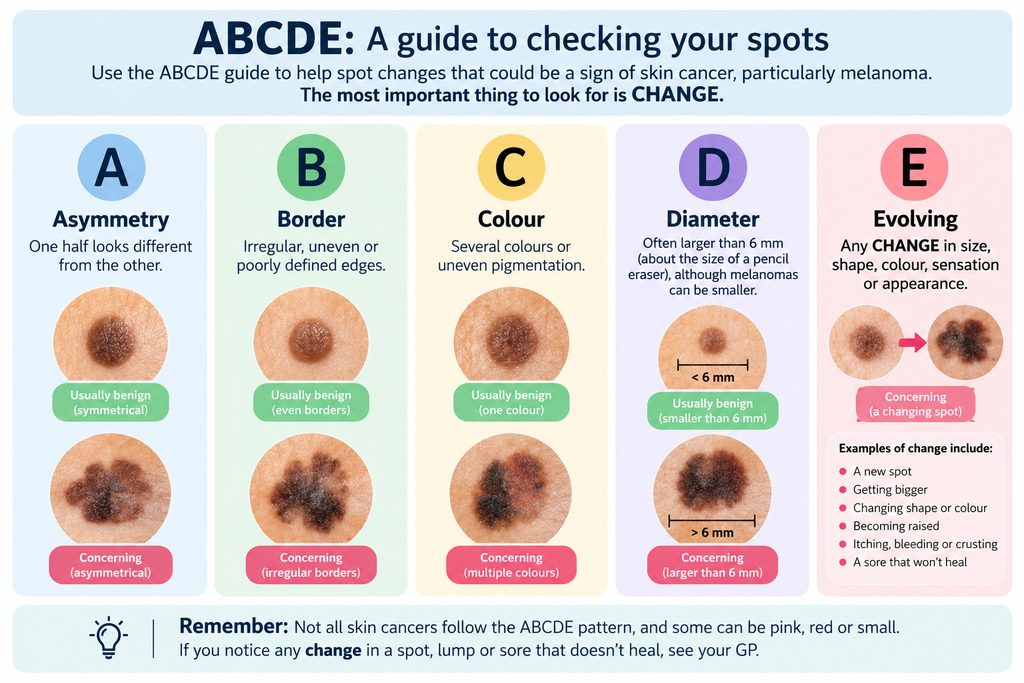
The most important letter is E: EVOLVING!
I tell my patients that CHANGE is the thing to watch for.
A new spot, an old mole changing appearance, a sore that won’t heal, or something that bleeds, crusts or looks different from your other spots deserves attention.
Not all melanomas follow the ABCDE pattern. Some appear pink or red, and some are small.
Check your skin regularly, including your back, scalp, soles of your feet and between your toes. Ask someone to help with the bits you can’t see.
I recommend people take whole-body photos with their phone every year (get assistance!) as this is useful for comparison, both for you and when you see your doctor.
Keep these photos in a separate, private album so pictures of you in your underpants don’t suddenly appear on the family shared photo screen. Just saying, from experience!
If you notice something changing, book an appointment with your GP rather than waiting for your next routine skin check. Just don’t ask me to look at a spot when I am at a party, go see your own GP and get a proper assessment with a dermatoscope. You owe it to yourself.
Should everyone have an annual skin check?
Not necessarily.
The RACGP recommends a risk-based approach rather than routine whole-body screening for every Australian.
People with previous skin cancers, numerous or unusual moles, fair skin, significant sun damage, a strong family history or immune suppression may need more frequent checks.
Your GP can assess your individual risk, examine suspicious spots using a dermatoscope (I love mine, it magnifies things by 20 times and has a very bright light!) and then recommend an appropriate follow-up plan.
For some people, this may include referral to a dermatologist or mole-mapping service.
What about vitamin D? Don’t we need sunshine?
Yes, vitamin D is important, particularly for healthy bones, muscles and calcium absorption.
But here’s the important distinction: We need vitamin D. We don’t need sunburn or a suntan.
Our skin produces vitamin D when exposed to UVB radiation, and many Australians maintain adequate levels through incidental sun exposure, such as going out to the clothesline to hang out the washing.
However, deliberate sunbaking is not recommended to increase vitamin D.
People with darker skin, those who cover most of their skin, people who spend little time outdoors, and some older adults or people with obesity or certain medical conditions may be at increased risk of deficiency.
Routine vitamin D blood testing isn’t recommended for everyone.
If you’re at risk, talk with your GP about whether testing or supplementation is appropriate. Vitamin D supplements can correct deficiency without exposing your skin to harmful UV radiation.
And remember, vitamin D isn’t a miracle supplement for preventing every disease. Its clearest established benefits relate to bone health and the prevention or treatment of deficiency.
My take-home message
Looking after your skin doesn’t mean giving up the outdoors.
It means enjoying Australia’s wonderful lifestyle while protecting yourself from unnecessary UV damage.
Check the UV on your chosen phone app. Protect your skin. Know your spots. And above all, pay attention to CHANGE.
Your skin has looked after you for decades. Perhaps it’s time to return the favour.
And if something doesn’t look right, see your GP. We’d much rather examine a harmless spot than miss something important.
Reliable Australian health resources
For more information about skin cancer, prevention, sun protection and vitamin D:
- Melanoma Institute Australia: How to prevent melanoma – Practical sun safety tips and melanoma prevention advice.
- Australian Melanoma Research Foundation – Melanoma education, research and awareness.
- Better Health Channel – Victorian Government information on skin cancer, sun safety and vitamin D.
- Cancer Council Australia: Vitamin D – Vitamin D, sunlight and protecting your bones.
- Therapeutic Goods Administration – Australian sunscreen regulation, ingredient safety and product recall information.
Disclaimer
The information shared by LifeVest Pty Ltd is for general education and information only and is not medical advice. Please speak with your GP, specialist, or healthcare professional for advice about your own health and circumstances. We aim to keep our content accurate and up to date, however medical information and guidelines can change over time. External links are provided for convenience only and do not imply endorsement. LifeVest Pty Ltd is not responsible for any loss or harm resulting from reliance on information shared through our website, social media, or other communications.